Malawi remains among the world’s poorest economies with average monthly incomes below €130 (about K261 000), far below the Sub Saharan African average of about €300 (K603 000).
The findings contained in the 2026 World Inequality Report, produced with support from the United Nations Development Programme, the World Inequality Lab and the European Union, group Malawi alongside Burundi, Yemen, Mozambique, Somalia, the Democratic Republic of Congo, Madagascar, South Sudan, Niger and Chad as the poorest large countries globally based on income levels.
At the global level, monthly incomes average €1 300 (about K2.6 million), underscoring stark demographic and economic disparities.
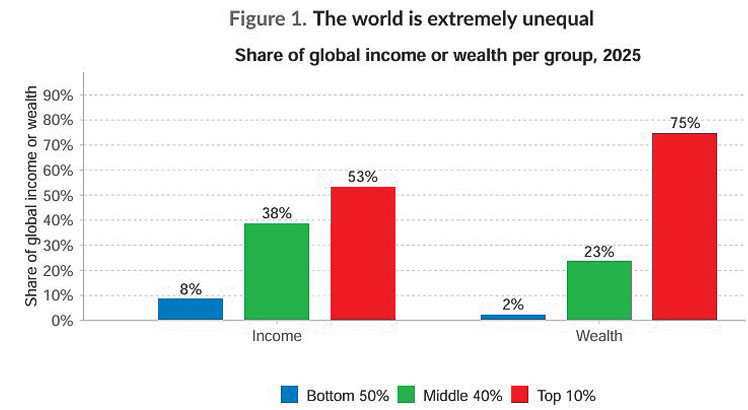
Regions with the largest populations, including Sub Saharan Africa, continue to record the lowest incomes despite global growth, according to the report.
On average, a person in Malawi earns about three times less than someone in Sub Saharan Africa and 10 times less than the global average, according to the report.
The report further indicates that within Malawi and across the region, inequality remains acute and the bottom 50 percent earn just eight to 11 percent of income, while the top 10 percent capture between 55 and 57 percent.
The richest one percent alone take more than double the share earned by the poorest half combined.
Lead author of the report and a researcher at the World Inequality Lab, Ricardo Gómez Carrera, is quoted as having argued that inequality is not inevitable but a political choice.
He said: “Progressive taxation slows compounding and provides resources that can fund public goods, which benefit everyone.
“Education is the closest thing we have to a universal equaliser. Investing in human capabilities is one of the few policies that reduces inequality and expands the economy at the same time.”
The revelations come as Malawi’s Commitment to Reducing Inequality Country Profile, launched by Oxfam, Norwegian Church Aid/DanChurchAid, Save the Children Malawi and the Malawi Economic Justice Network, highlighted stark disparities.
In an interview on Sunday, Centre for Social Concern economic governance officer Agnes Nyirongo observed that Malawi’s worsening macro-economic instability is increasingly undermining the welfare and incomes of ordinary citizens, as high inflation continues to erode purchasing power and push more households deeper into poverty.
“High inflation is acting like a hidden tax on the poor. Without urgent reforms to stabilise the economy and support income growth, living standards will continue to decline,” she said.
The report coincides with an upward revision of the minimum wage, effective from June 1 2026. Domestic workers will now earn a minimum of K83 720 (about €42) per month, up from K72 800 (€36), while commercial workers’ minimum has risen to K157 500 (€78) from K126 000 (€63).